


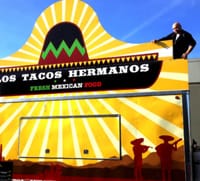
A wall wrap is a printed adhesive vinyl graphic applied directly to an interior or exterior wall as a durable alternative to paint. We design, print, and install building and wall wraps for retail spaces, restaurants, offices, warehouses, and trade show booths, and we have been wrapping buildings and walls for over 25 years.
What Building and Wall Wraps Are Used For

Inside a building, a wall wrap works as a mural, a lobby brand statement, a product story along a corridor, or wayfinding that people actually notice. Outside, it works as signage that covers an entire elevation of your building rather than a small panel above the door. Retailers use them to turn dead wall space into a selling surface, restaurants use them to set a room's atmosphere, warehouses use them to brand loading bays, and exhibitors use them as trade show backdrops that pack flat and travel.
The reason so many of our customers choose vinyl over paint comes down to what happens after the design is approved. A painted mural ties up your storefront while the painter works and locks you into that artwork until someone repaints it. A wrap is printed in our shop while your business stays open, installed in a fraction of the time, and taken off when your branding changes. If you want photography, gradients, product shots, or fine type on a wall, printed film reproduces all of it at a resolution a brush cannot match.
Surfaces We Wrap
The wall itself decides which film goes on it, and this is where most wall graphics succeed or fail. Before we quote anything, we look at what you are actually asking us to cover:
- Painted drywall and smooth plaster: The easiest surface we work with, and the best candidate for a film that comes off cleanly at the end of a lease.
- Brick, split-face block, and CMU: Deeply textured masonry needs a highly conformable cast film with an aggressive adhesive, heated and rolled into the mortar lines so the graphic reads as part of the wall instead of floating over it.
- Glass and storefront windows: We use clear, frosted, or perforated film depending on whether you want a full graphic, privacy with daylight, or a one-way image that customers see from the sidewalk while your staff still sees out.
- Metal, aluminum composite panel, and fiberglass: Smooth architectural panels take vinyl beautifully and are a common choice for warehouse elevations and loading bay doors.
- Elevator doors, cabs, and column wraps: Small, high-traffic surfaces where a graphic gets seen dozens of times a day, usually finished in a scuff-resistant laminate.
- Concrete, sealed floors, and tile: Floor graphics need a textured, slip-rated laminate rather than standard wall film.
Some surfaces are a poor fit, and we will tell you before you spend money. Heavy stucco, flaking or chalking paint, unsealed masonry, and walls that stay damp will not hold adhesive for long. In those cases, we usually recommend mounting the graphic on a rigid panel and fastening the panel to the wall instead.
Site Survey, Install Timeline, and Keeping Your Doors Open
- Site visit and measurements: We measure the wall, photograph it, check the texture and paint condition, and note obstructions like downspouts, conduit, thermostats, and window frames that the artwork has to work around.
- Design and proof: Our in-house design team builds the graphic around your existing logo and color scheme, scaled to the real wall dimensions. You see a proof laid over a photo of your own building before anything prints.
- Printing and lamination: Your artwork goes onto high-resolution vinyl film with the laminate matched to the surface and the environment it is going into.
- Surface prep: Walls get cleaned on installation day, since dust, grease, and cleaner residue are the usual culprits behind bubbling later. Freshly painted walls need time to cure before we apply anything, and new drywall needs longer still.
- Installation: We install in the right temperature window for the film, work panel by panel, and heat and post-heat textured areas so the vinyl stays down in the low spots.
Since the printing happens in our shop, the disruptive part of the project is short. Most single interior walls are installed in one visit, and we can schedule retail and restaurant work before opening or after close so your customers never see a ladder. Exterior elevations that need lift access take longer and depend on weather, and we will give you a realistic window rather than an optimistic one.
Permits, Landlords, and Lease-End Removal
Two approvals matter for exterior work, and one does not replace the other. Your municipality sets the sign code, and there is no national standard, so what your city allows for wall signage depends on your zoning district and the size of the elevation you want to cover. Separately, if you lease your space, your landlord or property manager almost certainly has written sign criteria covering permitted locations, maximum dimensions, and approved materials.
Get that criteria in writing before you fall in love with a design, and if a permit application is coming, ask the owner for a letter that names the wall, the graphic size, and their authorization to install. We work across our service areas in Washington, California, and beyond, and local sign rules vary from one city to the next, so start those conversations early.
Our Wall Wrap Materials and 7-Year Warranty
We print building and wall wraps on the same equipment and the same 3M and Avery cast vinyl we use for our vehicle wraps, finished with a UV protection layer so colors hold up. That material choice is why we can guarantee our building and wall wraps for 7 years.
Wall wraps are not only a commercial tool, either. Photography, artwork, and custom patterns print onto the same film for interior design work in homes, studios, and hospitality spaces.
Gallery ShowcaseFrequently Asked Questions
A wall wrap is a printed adhesive vinyl graphic applied directly to an interior or exterior wall as a durable alternative to paint. It works inside offices, stores, and homes, and outside on building facades, and it gives you more design flexibility than paint because photographs and fine detail print cleanly.
Pricing is quoted by the square foot and depends on the wall size, the surface, the film it requires, and whether the install needs lift access. Interior drywall is the lowest cost per square foot, textured exterior masonry at height is the highest, and larger walls cost less per square foot than small ones.
We guarantee building and wall wraps for 7 years. Interior graphics commonly outlast that warranty because they see no sun or weather, while exterior wraps depend on how much direct UV the wall takes.
Painted drywall, brick, concrete block, glass, metal panel, elevator doors, and sealed concrete all take vinyl well. Rough stucco, chalking paint, and damp walls do not, and we will recommend a panel-mounted graphic instead if that is what your wall calls for.
Not if the film was chosen with removal in mind. Tell us the graphic is temporary or tied to a lease term and we will spec a removable adhesive, then lift it with controlled heat so it peels away without taking your finish with it.
Usually yes for exterior signage, and the rules are set locally rather than nationally. You will also need your landlord's written sign approval if you lease. We are happy to talk through what your project involves before you file anything.